Showing posts with label Top10. Show all posts

Friday, January 7, 2011

Ten Wildest Hotels Around the World


High thread count sheets are nice, but for a luxury hotel to really impress us we want outrageous architecture, decadent decor, and edge-of-the-earth locations. It’s a tall order, but with a search across the globe we’ve found the top hotels that shatter all expectation. So whether you’re planning an escape for a few days or just want to take a virtual trip around the world, check out 11 hotels that bring the best in art, design, and adventure under one roof.

Barcelo Raval Hotel, Barcelona, Spain (above)

The sheer chance to chill in this lobby would be a vacation in and of itself. The flashy new Barcelo Raval in Barcelona is girly and enticing. In the lobby, the hot magenta seating dominates against the dazzling sparkles of the interior column and stark black and white. Rooms start at $139. BarceloRaval.com
Great Wall Kempinski, Beijing
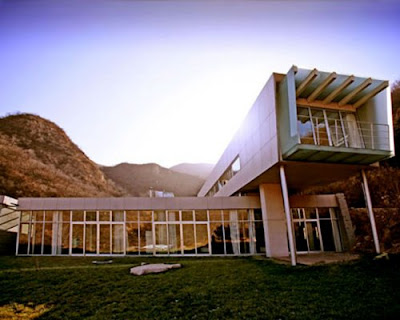
Commune by the Great Wall Kempinski, Beijing

Nestled in the Shuiguan Mountains and spread over eight square kilometers along the Great Wall of China, this collection of properties boasts some of the most creative and modern architecture in the area. Each of the 236 rooms and suites scattered across the commune offer views of the Great Wall. This one, the “See and Seen House” by architect Cui Kai, is a bona fide glass masterpiece. Rooms start at $366. CommunebytheGreatWall.com

Ice Hotel, Jukkasjarvi, Sweden

Ice Hotel, Jukkasjarvi, Sweden

What first opened in 1990 as an exhibit by a French ice artist has since become a magical and rather chilly chance for guests from around the world to experience the feeling of sleeping in an igloo. Crafted from ice and snow, each year Ice Hotel is rebuilt by visiting artists and creators. Though the temperature never drops below 23 degrees Fahrenheit, guests don thermal underwear and hats and slip into a sleeping bag atop blocks of ice, a thick mattress, and reindeer skins. Here, a magical chandelier hangs in one of last year’s halls. Open December 10 to mid-April yearly. Rooms start at $303 per night. IceHotel.com
Boscolo Hotel Exedra, Nice, France

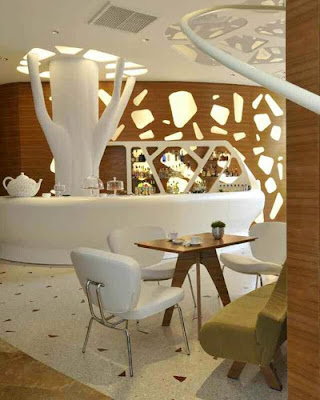
Boscolo Hotel Exedra, Nice, France

Though the recently opened hotel in France has been built in the Belle Epoque style, the hotel’s interiors are hardly antiquated. The bar, designed by Massimo Iosa Ghini, uses treelike sculptures and scattered lights across the walls and ceilings to create an organic yet futuristic feeling. Rooms start at $325. BoscoloHotels.com

Burj Al Arab, Dubai, United Arab Emirates

Burj Al Arab, Dubai, United Arab Emirates

Sitting on a man-made island located just off the shore, this modern and fanciful hotel has the effect of a sailboat drifting off to sea. At 321 meters high, this Tom Wright design stands as one of the world’s tallest hotel buildings and has become an icon of the Dubai skyline. Rooms start at $1000. Jumeirah.com

Hotel Fox, Copenhagen, Denmark

Hotel Fox, Copenhagen, Denmark

Composed of 61 rooms designed and decorated by 21 artists and groups, Hotel Fox takes art, urban living, and personal expression to a whole new level. Some of our favorites are the blue-and-yellow-checked masterpiece by Miami designers Friendswithyou; the playful expanse of aqua walls crafted by France’s Antoine et Manuel; the stark black-and-white words and statistics from E-Types of Denmark; and France’s Genevieve Gauckler's graphic space that literally commands guests to “SLEEP!” Rooms start at $165. HotelFox.com
Poseidon Undersea Resort, Fiji

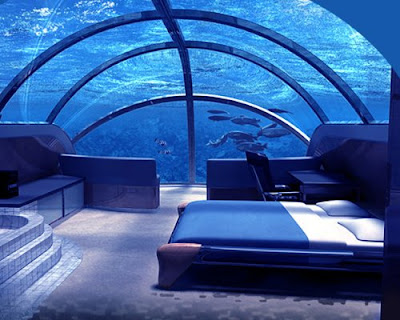
Poseidon Undersea Resort, Fiji

Nestled in the cerulean waters of a Fiji lagoon and accessible only by elevator are suites submerged a full 40 feet underwater. No oxygen required, it has all the luxuries of an aboveground getaway but with an unparalleled view. A weeklong stay (at the price of $15,000 per head) is split between the underwater suite and beach cabana accommodations so visitors can still fall asleep to the waves and the hotel can handle the high-demand for ocean immersion. Opens in early 2010. Reservations can be made beginning September 15. PoseidonResorts.com
La Purificadora, Puebla, Mexico

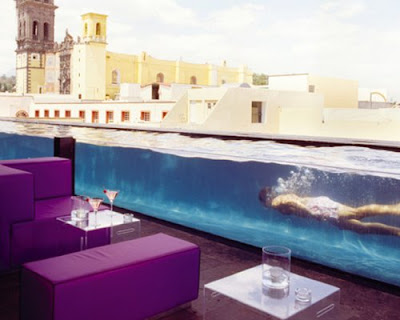
La Purificadora, Puebla, Mexico

Mexican hotelier Carlos Couturier turned a former 19th-century water-purifying center in a colonial city into this minimalist and modern traveler’s space. Here, the juxtaposition of purple modular furniture and an aquarium-esque pool against the traditional Iglesia de San Francisco is just one of the aspects that gives La Purificadora its old-meets-new charm. Rooms start at $155. LaPurificadora.com

Les Cols Pavellones, Olot, Spain

Les Cols Pavellones, Olot, Spain

With doors, walls, ceilings, and even floors made completely of green glass and black steel, this surreal space is futuristic, eerie, and intriguing all at once. But though it may seem stark, the glass construction welcomes the influence of nature and adds organic style. Here, a glass floor allows a visitor to view the raw earth beneath. Rooms start at $355. LesCols.com
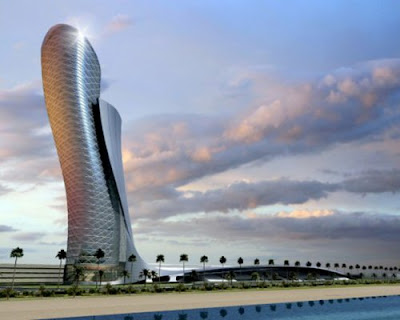
Hyatt Capital Gate Tower, Abu Dhabi

Hyatt Capital Gate Tower, Abu Dhabi, United Arab Emirates

Tuesday, January 4, 2011

Top Ten Coolest Aquariums


1. AquaDom: World's Largest Cylindrical Aquarium


The AquaDom breaks all records as the largest cylinder aquarium in the world, at over 25 meters high. Filled with about 900,000 liters of seawater, it contains some 2600 fish of 56 species. It is placed at the lobby of the Radisson SAS Hotel in Berlin.

Combined with a vast amount of sandblasted glass, the giant AquaDom gives a transparent-like feeling to the lobby. Guests and visitors are able to travel through the aquarium in a glass-enclosed elevator to reach a sightseeing point and restaurant under the glass roof. Two full-time divers are responsible for the care and feeding of the fish and maintenance of the aquarium. The AquaDom was opened in December 2003. It cost about 12.8 million euros.

2. Okinawa Churaumi Aquarium In Japan


The Okinawa Churaumi Aquarium is the world's second largest aquarium and part of the Ocean Expo Park located in Okinawa, Japan. The main tank holds 7,500-cubic meters of water and features the world's largest acrylic glass panel, measuring 8.2 meters by 22.5 meters with a thickness of 60 centimeters. Whale sharks and manta rays are kept amongst many other fish and plant species in the main tank.
The aquarium is currently trying to breed Whale Sharks.

3. Pieter van Suijlekom's Reef Aquarium


Pieter van Suijlekom’s Reef Aquarium is a fantastic saltwater tank system with a total volume of 2074 gallons.

4. Fish Highway Aquarium


The Fish Highway is a water-filled overhead tunnel connecting two (or more) aquariums. As long as no air gets in, fish can travel from one tank to another! For a simpler version, you might try the Fish Condo, which is three connected fishbowls.

5. Artistic Aquarium


The aquarium can be work of art, or it can be the medium for art. Takashi Amano introduced Japanese gardening techniques into aquascaping, turning them into displays of natural art.

6. Phone Booth Aquarium

Benoit Deseille and Benedetto Bufalino turned a phone booth into an aquarium as part of FĂȘte des lumieres 2007 (Light Festival) in Lyon, France.

7. Toilet Aquarium


Teach a man to fish, and you have fed him for a lifetime. Put some fish in a man's toilet, and he will never have a boring trip to the pot again. This is the clever thinking behind the Fish 'n Flush.

Fish 'n Flush is a patented, two-piece aquarium toilet tank, designed by AquaOne Technologies, Inc., an innovator of water-management systems. The aquarium has a 2.2-gallon capacity. When you flush, it looks like all the water is draining out of the tank and the fish are going down, but it's an optical illusion: the fish are actually safe in an outer aquarium made of high-polished plastic. What you see draining is the toilet water in a separate tank behind the aquarium.

8. TV Aquarium


Ever wondered what to do with that ancient 26" wooden TV set laying around in yours or your grandparent's garage? Here's a perfect destination for it! Even if you don't have the old TV, it shouldn't be too hard to buy one for almost nothing, and in no time you can have your favorite program broadcasting all day long, with no commercials.

9. Car Aquarium

At the Siam Ocean World in the Siam Paragon shopping center in Bangkok, there is a fabulous car there that cannot be driven. Why? Because it is filled to the top with water!

Dozens of fish call this extremely modified vehicle their home. And just so you know, the doors to this car are welded shut just in case any mischievous person thinks it funny to release that much water and fish onto the mall floor.

10. Sink Aquarium


Sunday, January 2, 2011

Ten Least Visited National Parks


1.Kobuk Valley

Far and away (no pun intended) the least visited of our national parks system, Kobuk Valley National Park attracted only 847 visitors in 2007. Located in the Arctic Circle, accessible only by foot, dogsled or snowmobile, and featuring exactly zero designated trails and roads, the park's title of least visited isn't really that surprising.

What Kobuk Valley lacks in user-friendliness, however, it more than makes up for in sand dunes and caribou. The park is also a great place to experience the anomaly of 24-hour daylight (but only for one month a year).

2.Lake Clark

Concentrating all the best that Alaskan wilderness has to offer into a single park, it is surprising Lake Clark National Park and Preservation had only 5,549 visitors in 2007. Lakes, active volcanoes, three mountain ranges, glaciers, waterfalls, arctic-like tundra and even a rainforest comprise this majestic park outside of Anchorage. Sled dog teams were the best way to travel around the area until the 1960s, but they have recently faced competition from snowmobiles.

At 6,297 square miles, Lake Clark National Park provides plenty of open space for your personal enjoyment. With an average of only 15 visitors per day, this means each visitor has 419 square miles of pristine national park to him or herself every day.

3.American Samoa

How many national parks can boast a rain forest and a coral reef? The National Park of American Samoa is unlike any other park, and if you weren't one of the park's 6,774 lucky visitors in 2007 (which, statistically, you probably weren't), we suggest you check it out.

The park, which spans three islands, offers a chance to see some great wildlife, from flying foxes to humpback whales. Admission to the park is free, which is good news because you'll probably need to book a couple flights to get there — and don't forget your passport. Sure, it's basically three-quarters of the way to Australia (a nonstop flight from Los Angeles takes about 10 hours), but the National Park of American Samoa is way cooler than one of those overcrowded touristy national parks.

4.Gates of the Arctic

Don't let Into the Wild scare you away from the almost-untouched-by-man natural beauty of the Gates of the Arctic National Park and Preserve. Considering it's roughly the size of Switzerland, it's surprising that only 10,942 people ventured through this Alaskan park in 2007.

Millennia of glaciation and erosion have carved out a breathtaking array of valleys, rivers, mountains and crystal-clear lakes. For an opportunity to enjoy tranquility like you've never experienced before, head north — far, far, north — to this park, where you're more likely to encounter a moose or caribou than another tourist.

5.Isle Royale

Isle Royale is a true hidden gem — perhaps this is why Michigan's state gemstone (Isle Royale greenstone) is named after the remote little island that's closer to Canada than it is to the States. Isle Royale is the largest island in Lake Superior, the greatest of the Great Lakes. Accessible only by boat or seaplane, Isle Royale National Park attracted 15,973 visitors in 2007.

Due to its remoteness, the island is populated by only about one third of the mammals that are found on the mainland. Interestingly, it is the only known place where wolves and moose live together without bears. If you don't like crowds (or bears) pack up the seaplane and head to Isle Royale National Park.

6.North Cascades

Considering its size and location (which is inconvenient, to say the least) it's no surprise Alaska has so many parks on this list. While Alaskan national parks feature some truly amazing stuff, North Cascades National Park in Washington provides an opportunity to experience Alaska-like wilderness closer to home. In addition to bears, moose and cougars, the park has the most glaciers (more than 300 of them!) outside of Alaska. Sadly, that number is steadily decreasing as global warming continues to claim its victims, so go see them while you can.

Located in northern Washington, the park is popular among backpackers and hikers. Its 400 miles of trails also make it accessible to less-adventurous outdoor lovers. North Cascades National Park was enjoyed by 19,534 visitors in 2007.

7.Dry Tortugas

Looking for sunken pirate ships and lost treasure? Civil War history buff? Really into masonry? If any of these apply to you, then Dry Tortugas National Park is the park for you. Seventy miles west of Key West are the Dry Tortugas islands, so-called because they lack surface fresh water ("dry") and Ponce de Leon caught a lot of sea turtles ("tortugas") here in the 1500s.

The centerpiece of the park is Fort Jefferson, a behemoth brick fortress originally intended to protect the U.S. from Gulf Coast invaders (namely pirates), but also used as a Union stronghold during the Civil War. The fort, although never completed, is comprised of more than 16 million bricks, making it the largest masonry structure in the Western Hemisphere.

Dry Tortugas is also a great place to watch migratory birds in the spring. With almost 300 bird species in the park, birdwatchers are in for quite a treat. As the 60,895 people who visited the park in 2007 can attest, Dry Tortugas National Park offers some great history in an idyllic setting.

8.Wrangell-St. Elias

The largest of all the national parks, Wrangell-St. Elias National Park and Preserve is actually larger than nine states. It is almost impossible to understand the scope of this park without experiencing it firsthand. Glaciers and mountains — many of which could support their own national parks — are the only ones crowded here. The park's 13 million acres provide a sprawling remote destination that is actually pretty accessible, as far as Alaskan national parks go. With 61,085 visitors in 2007, the park is increasing in popularity so enjoy its majesty before the Yellowstone crowd catches wind of it.

For those who just need some room to breathe, Wrangell-St. Elias National Park offers an average of 124 square miles per visitor, per day. That's the size of the country of Malta — and it's all waiting for you at Wrangell-St. Elias National Park. Smoky Mountain National Park, the most popular in the national park system, only offers a measly 0.03 square miles to each visitor each day.

9.Great Basin

Think of tourist destinations in Nevada and the first place your mind likely goes is Las Vegas. But our 36th state has so much more to offer than just strippers and slot machines. Head toward the Utah border and you'll find Great Basin National Park, which attracted 81,364 visitors in 2007.

Thanks to an almost complete lack of civilization in these parts, the night skies of Great Basin National Park are among the darkest in the country. Think of the park as the yin to Las Vegas' yang. Flashing neon lights are replaced with awesome, naked-eye views of the starry night — a rare opportunity for many. It's estimated that two-thirds of Americans cannot see the Milky Way from their backyards, and as light pollution continues to worsen, chances to observe the cosmos as nature intended might be running out.

10.Katmai

Katmai National Park in southern Alaska provides thrill seekers an opportunity to hike among 14 active volcanoes and the world's largest population of protected brown bears. Active volcanoes and thousands of brown bears not extreme enough for you? Well the National Park Service Website also warns visitors to expect only "some sunshine" and to "be prepared for stormy weather." And here's the kicker: it also offers the caveat that "light rain can last for days." Consider yourself warned.


Monday, December 27, 2010

The 10 Plankton of Christmas


Dr. Richard Kirby, a Royal Society Research Fellow at Plymouth University was going through his images of plankton with a festive eye in mind and discovered there were quite a few that fit with the season. In fact he ultimately came up with the "10 Plankton of Christmas."

10. A Candle: The larva of the starfish Luidia ciliarisPlankton of ChristmasAn unusual plankton here, the starfish larva body is the transparent part, while the orange is the juvenile starfish or Luidia sarsi. It detaches from the body and sinks to the floor while the leftover body keeps swimming with plankton until it dies.

Dr. Kirby continues: "Their (Planktons) importance on a global scale is obvious when you realize that 50 per cent of the world's photosynthesis takes place in the surface of the sea, drawing carbon dioxide from the atmosphere into the oceans and releasing oxygen."

9. A Christmas Tree: The paddle worm Tomopteris helgolandica

Plankton of Christmas This beautiful "tree" is actually an upside down paddle worm with its tentacles flowing back down its sides. It swims with a paddling motion, hence its common name while the Latin means "cut" and "wing." Some species will release glowing sparks when disturbed.

8. Fireworks: Protozoan Acantharea

Plankton of Christmas The golden color comes from symbiotic phytoplankton called zooxanthellae inside the single celled Acantharea. The needles are made out of celestite which many of us know as a pale blue beautiful mineral.

Underpinning the whole marine food chain, phytoplankton, which are plantlike and no bigger than the width of a human hair, are fed on by zooplankton.

7. Five Gold Rings: Spiral chains of the diatom Eucampia zodiacus

Plankton of Christmas"These diatoms and phytoplankton like them are the primary producers in the surface of the sea and account for 50% of all photosynthesis on Earth," Dr. Kirby explains. "Without the plankton food web, there would be no fish in the sea or seabirds in the skies above. The largest mammals on earth, the baleen whales, even rely upon these smallest of sea creatures for their food."

6. A Christmas Lantern: The doliolid Doliolum nationalisPlankton of ChristmasBelieve it or not, these Doliolids are actually distant relatives of ours. They swim by pumping water when they contract their body wall. Anyone swimming in the sea will have swallowed them without realizing it.

5. Santa's Hat: The larva of a sea anemone

Plankton of Christmas These larva of the sea anemone may not look familiar right now but they turn into gorgeous 'flowers of the sea" as the link shows. In the meantime, the ocean's Santas have their own hats!

Dr. Kirby says: "With sea temperatures rising as a result of a warming climate, the numbers and distribution of the plankton are changing with ramifications for the whole marine food chain, and the ecology of our planet."

4. Snowflakes: Baby brittle starsPlankton of ChristmasAbove you can see baby brittle stars ready to start their journey as adults after sinking to the sea floor. Brittle stars are near relatives of star fish and as adults have very long slim arms.

Dr. Kirby continues his explanation of the importance of plankton: "Your car is also fueled by their remains and over millions of years they created some of the most enigmatic features of our coastline. So when you drive your car to the festive family gathering it is all thanks to the processed plankton that fuel it. When you turn on the oven to cook the Christmas turkey, the gas comes from plankton that sank to the seafloor over hundreds of millions of years of earth's history."

3. Angels: Sea angels, Clione limacina

Plankton of Christmas Sea angels are sea slugs - the "wings" are modifications of their foot that they use to locomote and catch prey. Their prey are sea butterflies (another species of pteropod) and the angels have co-evolved to the point that even their metabolism is closely matched to that of their prey.

2. A Star: A baby Luidia ciliaris starfish

Plankton of Christmas This baby starfish, unusual with 7 arms has just detached from its larval body and is sinking to the sea floor to continue its growth - it will grow to be between 40 and 60 cm! The upper arms are pale orange to reddish orange but the lower are white. Some half bury themselves to catch urchins and bi-valves.

1. Bells: The jellyfish Aglantha digitale

Plankton of Christmas This tiny jellyfish is an important predator in the plankton food chain. It has 8 long sex glands just under the roof of the umbrellas and around 80 tiny tentacles at the base.